No products in the cart.
Craft, Religion, and Tradition
For someone who has dedicated their life to the craft of artisanship, visiting villages in Vietnam is an experience comparable to a pilgrimage to Mecca or the Vatican. It feels like arriving at the home of the master artisans we have always admired and longed to meet.
At the gates of these villages, rows of young women dressed in red silk wave flags and greet visitors. The first thing I noticed —perhaps due to my Taoist background— is that each village has a central hall or meeting place that invariably resembles a temple: monks dressed in black, consecration altars, and workspaces all gathered in one place.
Contrary to what one might expect from a “communist” country, religious beliefs here are firmly tied together in a single package where, I suspect, art and Taoism form an indivisible whole. The artisan gives shape to balance, to the golden mean, to the path of the Tao. I felt it as a communion of matter and spirit, united in the handcrafted product.
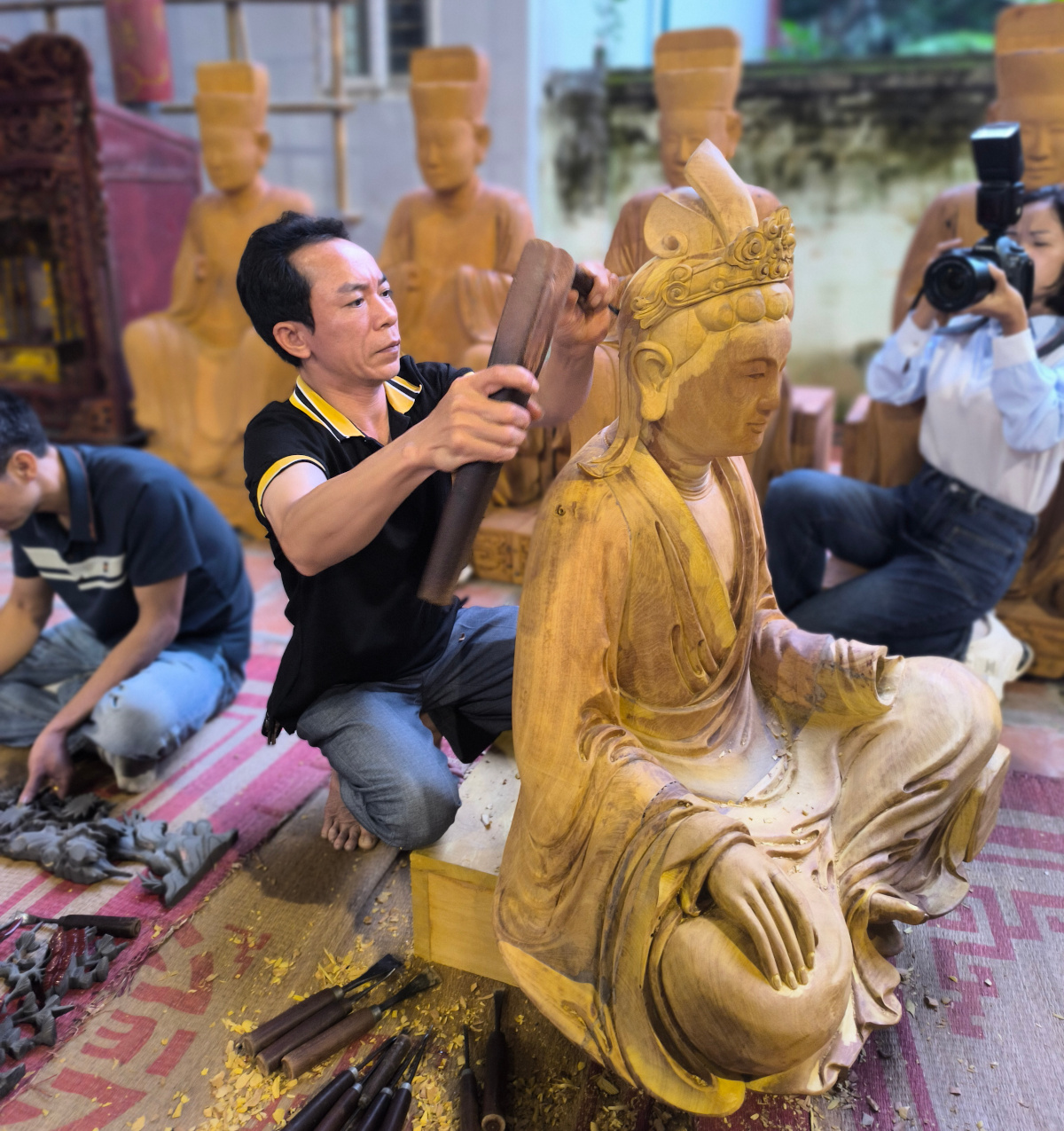
I was also surprised to find young people under 20 with the skills of master artisans. This means training begins at a very early age. As I mentioned in the first part of this blog, Vietnam applies a model that seems to have originated in Japan: the OVOP (One Village One Product) project. Thanks to this, I had the chance to visit villages dedicated to silk, wood carving, incense production, ceramics and porcelain, and others specializing in stone carving for ornamental, religious, and funerary purposes.
The technical level, production volume, and quality make our own crafts, by comparison, seem like little more than tropical curiosities.
To conclude, I want to share what I witnessed in a wood‑carving workshop at sunset. It felt like a dreamed metaphor, one of those hallucinatory experiences where you are not sure if it truly happened. The last rays of the sun bathed the artisans as they gave the final touches to carved wooden pieces. Some women burned the sculptures with torches, seeking that dark, antique look. Others, seated on low stools over a damp floor that resembled a small pool of water, applied sheets of gold—so thin they disintegrate in the hands of a novice.
Fire, gold, and water unfolded simultaneously. Fragments of gold flew like glitter, lifted by the hot air, then fell into the water and streamed like golden rivers at our feet. What kind of sensitivity is required to enjoy such a moment without searching for any reasoning?